
Macro Cycle

Analyzing the Distortion Effect of Government Subsidies on Semi FCF
Government subsidies have become a central feature of the modern semiconductor landscape. From grants and tax credits to low‑cost loans and direct equity participation, public programs now influence where fabs are built, how capacity is expanded, and which companies lead in critical technologies. On the surface, these subsidies often look like free or cheap money that improves investment economics.

2026 Global Semi CapEx Map: The Divergence Between Advanced and Mature Nodes
The semiconductor industry entered 2026 with a clearer, more bifurcated capital expenditure landscape than at any point in the past decade. As hyperscalers and AI-driven computing demands continue to escalate, foundries and integrated device manufacturers (IDMs) prioritize advanced-node capacity (3 nm, 2 nm and next-generation gate-all-around architectures).

Global Semi M&A Value Hits 5-Year High, Consolidation Wave Accelerates
When global semiconductor M&A value hits a five‑year high, it is more than a headline about deal flow—it is a structural signal. Rising transaction values and a thick pipeline of strategic deals tell us that industry leaders believe scale, integration, and portfolio breadth are increasingly essential in a market shaped by AI, automotive electrification, industrial automation, and geopolitical tension. The current consolidation wave is not the first the sector has seen, but it is distinct in scope and motivation.

The Unexpected Correlation Between Semi Sentiment and Crypto Mining Demand
Semiconductors and cryptocurrencies might seem like inhabitants of different worlds: one, a physical industry of fabs, wafers, and equipment; the other, a digital realm of tokens, blockchains, and speculative cycles. Yet over the past decade, an unexpected correlation has emerged between sentiment in the semiconductor sector and demand from crypto mining. When miners are euphoric and building out capacity, semi sentiment often improves;

SE Asia’s Share of Global OSAT Capacity Breaks 20% for the First Time
Outsourced Semiconductor Assembly and Test (OSAT) has long been the quiet backbone of the chip industry, turning bare wafers into usable, reliable packaged devices. For decades, much of the attention has focused on front‑end fabrication hubs in the US, Europe, Taiwan, Korea, and increasingly China.

Regional Reconfiguration of Global Semi Supply Chain: US-EU-SEA Triangle
The global semiconductor supply chain is undergoing a profound regional restructuring. Instead of a largely Asia‑centric manufacturing network feeding design and demand hubs elsewhere, the industry is evolving into a more segmented, multi‑pole system anchored by three increasingly distinct regions: the United States, the European Union, and Southeast Asia (SEA).

2H 2026 Semi Order Visibility Survey: Views from 50 Procurement Managers
As the semiconductor industry enters the second half of 2026, procurement teams find themselves in a markedly different environment than the one that defined the past three years. Shortages and emergency allocation have receded, inventories have largely normalized, and new regional capacity is ramping under various industrial policy programs.
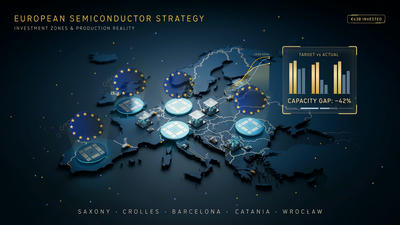
Europe’s Chips Act Catch-Up Dilemma: The Gap Between Capacity Targets and Reality
Europe’s Chips Act was launched with a bold ambition: to roughly double the continent’s share of global semiconductor production and secure strategic autonomy in a technology that underpins everything from cars and industrial equipment to cloud computing and defense systems. Policymakers framed it as a catch‑up mechanism—Europe would move from dependence on foreign fabs toward a more balanced, resilient ecosystem.

The Structural Contradiction of Layoffs and Mass Hiring Co-Existing in Semi Industry
The semiconductor industry has always been cyclical, but the current moment feels particularly paradoxical. In the same headlines, we see announcements of layoffs, hiring freezes, and project cancellations alongside news of massive recruitment drives, new fab construction, and aggressive talent campaigns.
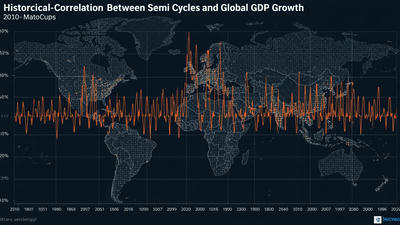
Historical Correlation Between Semi Cycles and Global GDP Growth
Semiconductor industry cycles and global GDP growth are deeply intertwined. Semiconductors power consumer electronics, data centers, automobiles, industrial automation, and countless embedded systems that form the backbone of modern economic activity. Conversely, macroeconomic conditions shape consumer demand, corporate capex, and the financing environment that determine fab investment and inventory behavior.
Popular

Narrowing Spread Between NAND Spot and Contract Prices in 2026 – A Signal
By 2026, one of the most watched metrics in the NAND flash market has started to shift in a subtle but meaningful way: the spread between spot prices and long‑term contract prices is narrowing. For casual observers, this may look like just another incremental change in a notoriously volatile industry. For memory makers, module houses, device OEMs, and data center buyers, however, a tightening gap between spot and contract prices is a signal—a reflection of evolving supply–demand balance, risk perceptions, and strategic behavior on both sides of the market.

Price Divergence Trading Strategies Between NAND Flash and DRAM ETFs
NAND flash and DRAM sit at the core of AI storage and computing power. Both are memory, but they are not the same business. DRAM is main memory—fast, volatile, and central to high‑bandwidth workloads like AI training and inference. NAND is non‑volatile storage—slower than DRAM, but crucial to persistent data and large‑scale object storage. The cycles that drive their pricing and margins overlap, yet they often diverge. That divergence is where trading strategies between NAND and DRAM ETFs become interesting.

China’s HBM Localization Progress: The Catch-Up Pace of CXMT and XMC
China’s drive to localize advanced memory technologies has accelerated over the past several years. High-Bandwidth Memory (HBM) sits near the center of that strategy because it is integral to AI accelerators, high-performance computing (HPC) and other strategic compute platforms. Two domestic players—ChangXin Memory Technologies (CXMT) and XMC (Xianghui Memory, commonly referred to as XMC)—have become focal points in assessing how quickly China can close the gap with international incumbents on HBM die, stacking, and packaging.